Driver Safety: What the Data Says and What Most DSPs Actually Do
The gap between what the telematics shows and what gets acted on — and how to close it before an incident does it for you.
The behavior patterns that precede most incidents show up in telematics data days or weeks before they cause harm.
Feedback connected to a specific behavior within 48 hours changes it. Feedback delivered a week later rarely does.
The average cost of a single delivery incident — vehicle damage, insurance, scorecard — vs the cost of one coaching conversation.
Which driver is speeding, on which road, at what time of day. The pattern is visible within two weeks of starting.
Repeated hard braking at the same location means a route issue. Repeated hard braking everywhere means a driver issue.
A driver who removes their seatbelt on residential streets has a clear, documentable pattern before any incident occurs.
Telematics flags phone handling events. The flag appears in the system the same day. Most DSPs see it days later — if ever.
One flag gets noted. Four flags in a week get a mention at the next stand-up. Eight flags get a conversation — six weeks later.
"The roads are bad this time of year." The pattern goes unaddressed until the same driver has a fender bender on a dry day.
The first flag is a glitch. The fifth flag is still a glitch. The conversation happens after an incident — not before it.
The report exists. Nobody has time to pull it this week. Nobody pulls it next week either. The pattern compounds unaddressed.
The telematics report from Tuesday shows three hard braking events on Route 7 and a seatbelt flag on the same driver. The manager sees it Friday afternoon, plans to bring it up Monday. Monday is busy. Wednesday the driver has a minor collision at a residential stop. The scorecard drops. The coaching conversation happens — three weeks after the data that would have prevented it.
Every DSP with a telematics system has the same problem: the data is there, the flags are visible, and nothing happens until something breaks. The telematics system is doing its job. The gap is in what happens — or doesn't happen — with what it shows. A manager who sees three flags on a driver and plans to mention it at the next stand-up is already behind. The driver has had four more shifts since those flags fired.
The operations that maintain strong safety records aren't the ones that react fastest when the scorecard drops — they're the ones that act on the telematics data before the scorecard has a chance to reflect it. Here's what that looks like in practice, and how to build the habit before an incident builds it for you.

The Data Only Works If Someone Actually Looks at It
Telematics data is only useful if it gets reviewed on a fixed schedule by someone with the authority to act on it. A safety flag that sits in a report nobody opened is the same as no flag at all. The weekly review habit is the simplest and most impactful safety practice available to a DSP — not because it's complicated, but because most operations don't do it consistently. Same person, same day, same four metrics — every single week.
Same four reports, same person, same Monday morning — before the stand-up starts.
Speeding, hard braking, seatbelt, distraction — the four signals that precede most incidents.
One event is a note. Three events on the same driver in the same week is a coaching conversation.
Feedback connected to behavior within 48 hours changes it. Delivered a week later, it rarely does.
How many events, which driver, which road, what time. A single event is a note. Three events on the same driver in the same week is a pattern that needs a conversation before it becomes four.
High riskRepeated hard braking at the same location is a route problem. Repeated hard braking everywhere is a driver problem. The distinction matters — one needs a routing fix, the other needs a coaching conversation.
High riskA seatbelt flag on a driver who wears it ninety percent of the time is very different from a driver who removes it on residential streets. The weekly review shows you which one you're dealing with.
Medium riskPhone handling events flagged by telematics. The data exists in the system. Most DSPs never pull it — which means the most dangerous behavior pattern goes entirely unaddressed until something forces it.
High riskSpeeding, hard braking, seatbelt, distraction — one pull, same four reports every Monday morning before the stand-up.
Three or more events on the same driver in the same week triggers a flag. One event is a note. Three is a pattern.
Hard braking at the same intersection every day is a route fix. Hard braking on every route is a driver conversation.
Any flagged driver gets a coaching conversation within 48 hours — not at the next convenient moment.
Did the behavior change after last week's conversation? If yes — note it. If no — escalate. The log is accountability.
The weekly review isn't a safety program — it's a twenty-minute Monday habit. The difference between an operation that catches safety patterns early and one that discovers them in an incident report is almost always this: one manager opens four reports every Monday morning and the other opens them when something goes wrong. That's the entire gap. Build the habit before the incident builds it for you.
The Conversation That Changes Behavior — And the One That Doesn't
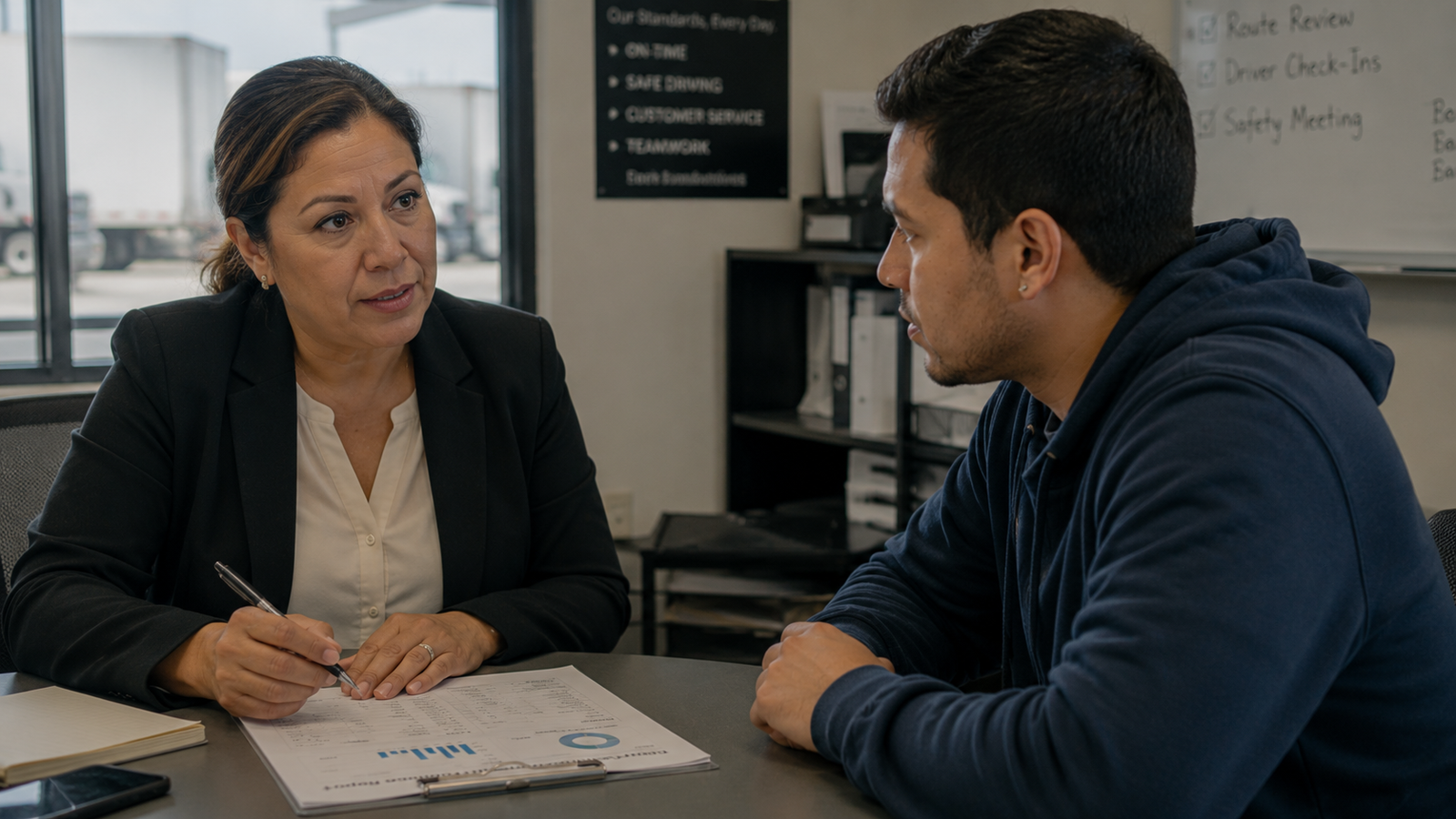
Most DSP owners know they should coach drivers on safety. The problem isn't intent — it's execution. A coaching conversation that happens three weeks after the flag, in a rushed five-minute window between routes, without specific data, without a clear ask, and without any follow-up is not a coaching conversation. It's a mention. Mentions don't change behavior. Specific, timely, data-backed conversations do — and the difference between the two is almost entirely about how the conversation is structured, not how long it takes.
Three or more events of the same type in one week. The data shows a clear pattern — this conversation is about naming it specifically.
One event — not yet a pattern but worth addressing early. This conversation sets the expectation before it becomes a habit.
The coaching conversation happened last week. This week the behavior changed — or didn't. Both outcomes need a conversation.
Three coaching conversations. Same behavior. No improvement. This conversation is different in tone, structure, and consequence.
"I pulled your telematics from this week. You had four speeding events on Tuesday and Wednesday — all on Oak Street between 2 and 4pm."
Opening with specific data instead of a judgment ("you've been speeding") removes the defensive reaction. The driver is responding to a fact, not an accusation. It also signals that you've actually looked at the data — which matters for credibility.
"What's happening on that stretch at that time of day? Is there something about that part of the route that's creating pressure?"
Asking first does two things: it gives you information you don't have (there may be a legitimate route issue), and it gives the driver ownership of the conversation. A driver who explains their own behavior is far more likely to change it than one who was told what they did wrong.
"The reason I'm flagging this isn't to create a problem for you — it's because a speeding incident on a residential street is the kind of thing that ends a driving career. I'd rather have this conversation than that one."
Drivers who understand why safety matters to their own livelihood — not just to Amazon's scorecard — internalize it differently. The conversation shifts from compliance to care. That shift changes behavior in a way that compliance pressure rarely does.
"What I'm asking for this week is one thing: on Oak Street between 2 and 4pm, stay at or below the posted limit regardless of how the day is going. Just that stretch, just that window. Can you do that?"
One specific ask is actionable. A list of safety improvements is overwhelming and forgettable. The driver leaves knowing exactly what changed and exactly where. The specificity is what makes it stick — and what makes the follow-up measurable.
"I'm going to pull your telematics again next Monday. If the Oak Street events are gone, that's the end of it. If they're still showing up, we'll talk again. Fair?"
Naming the follow-up before you close the conversation creates accountability without confrontation. The driver knows exactly what will happen next — which makes the ask feel real rather than performative. "We'll talk again" is not a threat. It's a commitment to follow through.
| Situation | Do this | Not this |
|---|---|---|
| Opening the conversation | "I pulled your telematics — here's what I saw"Specific, data-backed, non-judgmental opening. | "I've been meaning to talk to you about your driving"Vague, ominous, immediately defensive. |
| Describing the behavior | "Four events, Oak Street, Tuesday and Wednesday, 2–4pm"Specifics remove the argument about whether it happened. | "You've been speeding a lot lately""A lot" is debatable. Four events on a specific road isn't. |
| Timing of the conversation | Within 48 hours of the flag appearingBehavior and feedback are connected. The driver remembers the route. | At the next convenient moment — usually 2–3 weeks laterThe driver has no memory of the specific day. The feedback lands in a vacuum. |
| The ask at the end | "One thing: stay at the limit on Oak Street this week"One specific ask is actionable and measurable. | "Just be more careful out there going forward"No specificity — nothing to measure, nothing to follow up on. |
| Closing the conversation | "I'll check the data again Monday — let's see how it looks"Accountability built in before the conversation ends. | "Okay, thanks for your time"No follow-up named — conversation feels performative to the driver. |
The coaching conversation that changes behavior isn't longer than the one that doesn't — it's more specific. The data is specific, the behavior is specific, the ask is specific, and the follow-up is named before the conversation ends. That structure takes the same amount of time as a vague mention at the stand-up and produces a completely different outcome. Build the structure once. Run it every time a flag comes up. The behavior will follow.
The Coaching Conversation Is Not the Finish Line
Most DSP owners treat the coaching conversation as the endpoint. They had the conversation, they mentioned the data, they asked the driver to be more careful — and that's the end of the safety process until the next flag appears. The problem is that a conversation with no follow-up is not accountability — it's a request. And requests, without consequence or recognition, don't reliably change behavior. The tracking system is what turns a conversation into an outcome.
Check the next week's data the Monday after a coaching conversation — not when you remember to.
Three documented coaching conversations with no behavior change is the threshold for a formal escalation conversation.
The tracking log is five minutes per week. It's the difference between a safety program and a safety intention.
Driver name, flag type, date coached, outcome, next check date. One row per driver per flag. That's the entire tracking system.
| Driver | Flag type | 4-week trend | Last coached | Trend | Status |
|---|---|---|---|---|---|
|
Driver A
Route 3 — North zone
|
Speeding |
|
3 days ago | ↓ | Improving |
|
Driver B
Route 7 — South zone
|
Hard braking |
|
Route fix pending | → | Route issue |
|
Driver C
Route 5 — East zone
|
Seatbelt |
|
3 conversations | ↑ | Escalate |
|
Driver D
Route 2 — West zone
|
Distraction |
|
1 week ago | ↓ | Improving |
|
Driver E
Route 9 — Central zone
|
None this month |
|
— | ↓ | Clear |
The Monday after a coaching conversation, you pull the same driver's data. If the specific behavior improved, you acknowledge it. If it didn't, you have a second conversation. Without the log, you don't know which situation you're in — and you can't act on it either way.
Three documented conversations with no improvement is the threshold for a formal escalation. Without a log, you don't know if you've had one conversation or three — and the driver doesn't know either. The log makes the escalation conversation legitimate rather than subjective.
If a driver has an incident after three documented coaching conversations, the log is evidence that the operation took reasonable steps to address the behavior. Without documentation, the operation has no record of the conversations that happened — and the ones that didn't.
The tracking system doesn't need to be sophisticated. A spreadsheet with five columns — driver name, flag type, date of coaching conversation, behavior change yes or no, next review date — is the entire system. Five minutes per week to update it. The operations that have this in place catch escalation situations before they become incidents, acknowledge improvement before good drivers stop noticing that it matters, and protect themselves legally in a way that no amount of good intentions can replicate. Build it once. Run it every Monday. That's the whole thing.
What Four Weeks of Safety Tracking Actually Shows
Every DSP with a telematics system already has everything they need to maintain a strong safety record. The flags are there. The patterns are visible. The behavior that precedes most incidents shows up in the data days or weeks before it causes harm. The operations that act on it do three things consistently — review it weekly, coach within 48 hours, and track whether it worked. The ones that don't are one incident away from wishing they had.
Speeding, hard braking, seatbelt, distraction. Twenty minutes. Flag anything above three events on the same driver.
Use the five-step structure. Open with data. Ask before you tell. One specific ask. Name the follow-up before you close.
Driver, flag type, date coached, behavior change, next review. Set it up once. Update it every Monday. That's the system.
Safety doesn't improve because an operation cares about it — every operation cares about it. It improves because an operation builds the specific habits that turn caring into action. The weekly review, the 48-hour coaching conversation, and the five-minute tracking log are those habits. None of them are complicated. All of them require starting before something forces the issue. Start this Monday.