Peak Season Prep: What to Do Now Before the Rush Hits
The route, staffing, fleet, and communication decisions that separate a smooth peak from a chaotic one — and why the operations that sail through peak started preparing ninety days before it arrived.
Peak arrives. The operation absorbs it.
Volume climbs by forty percent. Routes get longer. Every driver is needed. The operation runs — not perfectly, but consistently — because the decisions that made this possible were made ninety days ago.
Two extra drivers hired and onboarded in September — already running routes before the volume spike.
Every van through a full service check in October. No breakdowns on the three busiest delivery days of the year.
Stop counts adjusted and sequences reviewed before volume climbed. No routes running two hours over.
Drivers know what to expect, who to call, and how updates will come. No confusion in the busiest week.
Peak arrives. The operation fractures.
Volume climbs by forty percent. Routes get longer. Every driver is needed — but two called out, one van is in the shop, and three routes are running two hours over. The scorecard is dropping in real time.
Hiring started in November. New drivers are still in onboarding when the volume spike arrives.
Brake job that should have happened in October. Route uncovered on the busiest delivery day of the year.
Stop counts unchanged from September. Drivers running two hours over. Rescues every afternoon.
Drivers getting conflicting information from three different channels. Confusion compounding the chaos.
The staffing decisions that cover December get made in September. Everything else flows from that timeline.
A forty percent volume spike on a system built for normal capacity will find every weakness that was manageable before.
Staffing, fleet, routes, and communication — all four need a peak-specific review before volume starts climbing.
The call comes in on a Tuesday in mid-November. Volume is already climbing and a van needs a brake job that should have been scheduled six weeks ago. Two routes are running ninety minutes over because the stop counts weren't adjusted. And the two drivers hired last week are still in onboarding. This is not bad luck — it's the consequence of preparation that started too late.
Peak season in last-mile delivery is the ultimate stress test. Volume spikes, routes get longer, drivers get tired, and every operational weakness that was manageable in August becomes a crisis in November. The DSPs that handle peak well aren't the ones with the most drivers or the biggest fleet — they're the ones that started preparing before peak felt urgent, when there was still time to fix the things that would break under pressure.
The staffing decisions that determine whether you're covered in December get made in September. The fleet maintenance that prevents a breakdown on your busiest delivery day happens in October. The communication protocols that keep drivers calm during a chaotic peak week get built and practiced in the weeks before volume climbs. Here's what that preparation looks like — and when to do each piece of it.

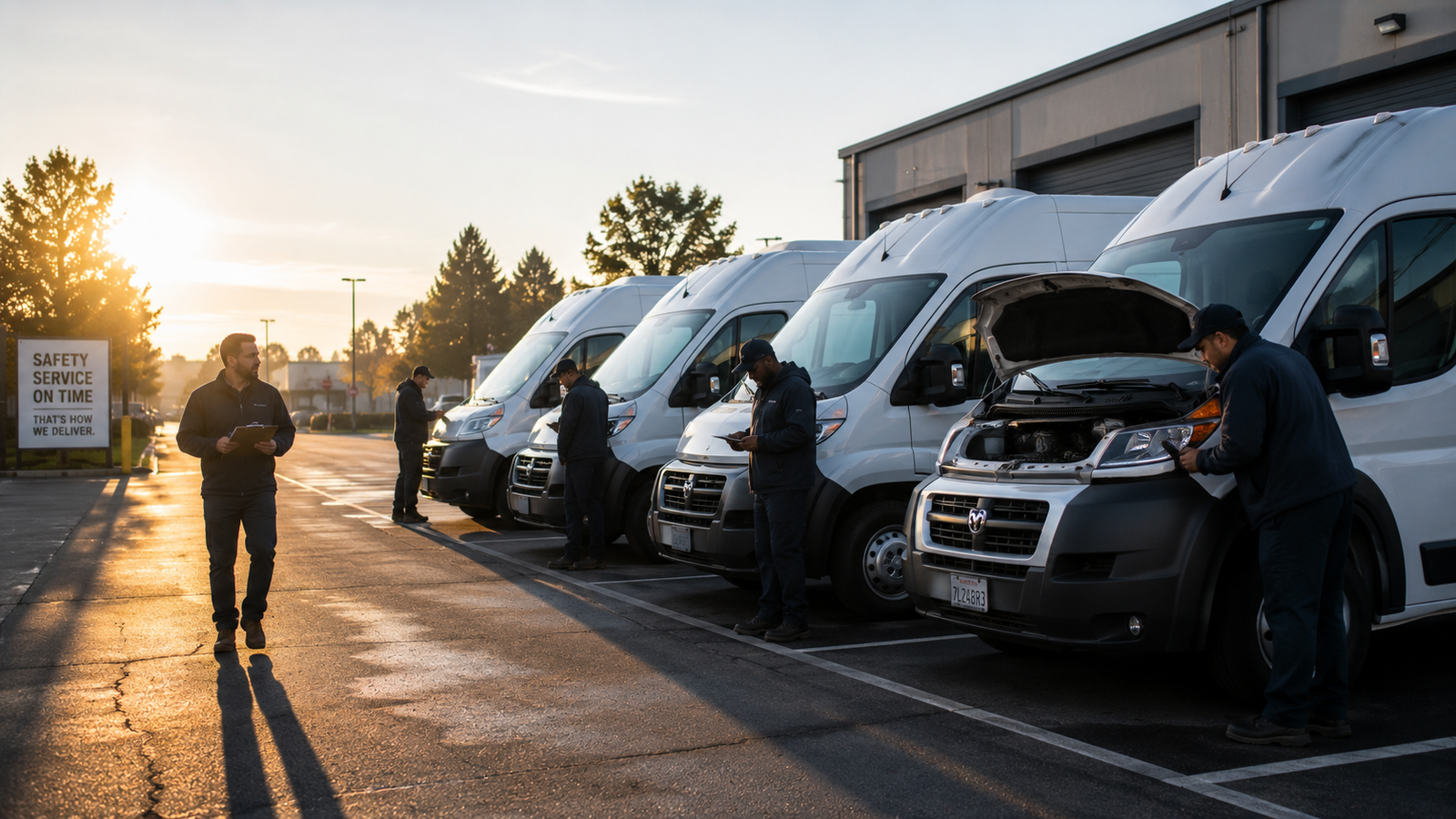
Fleet checks before the volume climbs — the operations that service every van in October are the ones with no breakdowns in December. The window is shorter than it looks.
Peak preparation has four parts — staffing, fleet, routes, and communication — and each one has a deadline that most DSP owners miss because the urgency doesn't feel real until the volume is already climbing. By the time it feels urgent, the hiring window has closed, the service bays are booked out three weeks, and there's no time to recalibrate routes without disrupting drivers who are already under pressure. The work has to happen before it feels necessary.
Here's what each of the four preparation areas looks like when it's done right — what to do, when to do it, and what it costs to leave it until peak is already at the door.
Hire Before You Need To — Peak Staffing Starts in September
The single most common peak season failure is a staffing gap that could have been closed two months earlier. Hiring in November for December volume means new drivers are still in onboarding when the busiest week of the year arrives. The window to hire, onboard, and get new drivers running confidently on routes closes in October — which means the decision to start hiring has to happen in September, when the operation feels fully staffed and the urgency isn't there yet.
Before you post a single job, calculate exactly how many drivers you need to cover peak volume — not comfortable volume, not normal volume, peak volume. Add a buffer of two above that number to account for call-outs on high-pressure days. That total is your September hiring target.
New peak hires need to be on routes and building confidence before volume starts climbing — not learning routes while managing peak pressure. A driver who starts in October has six weeks of real experience before December. A driver who starts in November has two weeks of onboarding and then immediately hits the hardest delivery conditions of the year.
Peak staffing isn't just about having enough drivers on normal days — it's about having coverage when two call out on the same morning in the busiest week of the year. A standby bench of two to three reliable drivers who understand the routes and can step in with minimal notice is the difference between a manageable peak morning and a crisis one.
October hiring means November onboarding means December inexperience. Every week the hiring decision gets delayed pushes new drivers deeper into peak before they're ready for it.
Staffing at exactly the right number for normal volume means staffing at two or three below what peak requires. The buffer isn't optional — it's the difference between a manageable call-out and a route that doesn't get covered.
On the busiest morning of the year, someone will call out. The operations that sail through that moment are the ones with a tested standby bench. The ones that don't have one spend that morning making calls and hoping for the best.
The staffing preparation window for peak closes faster than it seems. By the time November arrives and the volume starts climbing, every hiring decision has already been made — either deliberately in September or reactively under pressure. The September hire who has been running routes for six weeks is ready for peak. The November hire who just finished onboarding is not. Make the decision in September and the rest follows. Wait until November and you're managing the consequences of that delay for the entire peak season.
Service Every Van Before the Service Windows Close
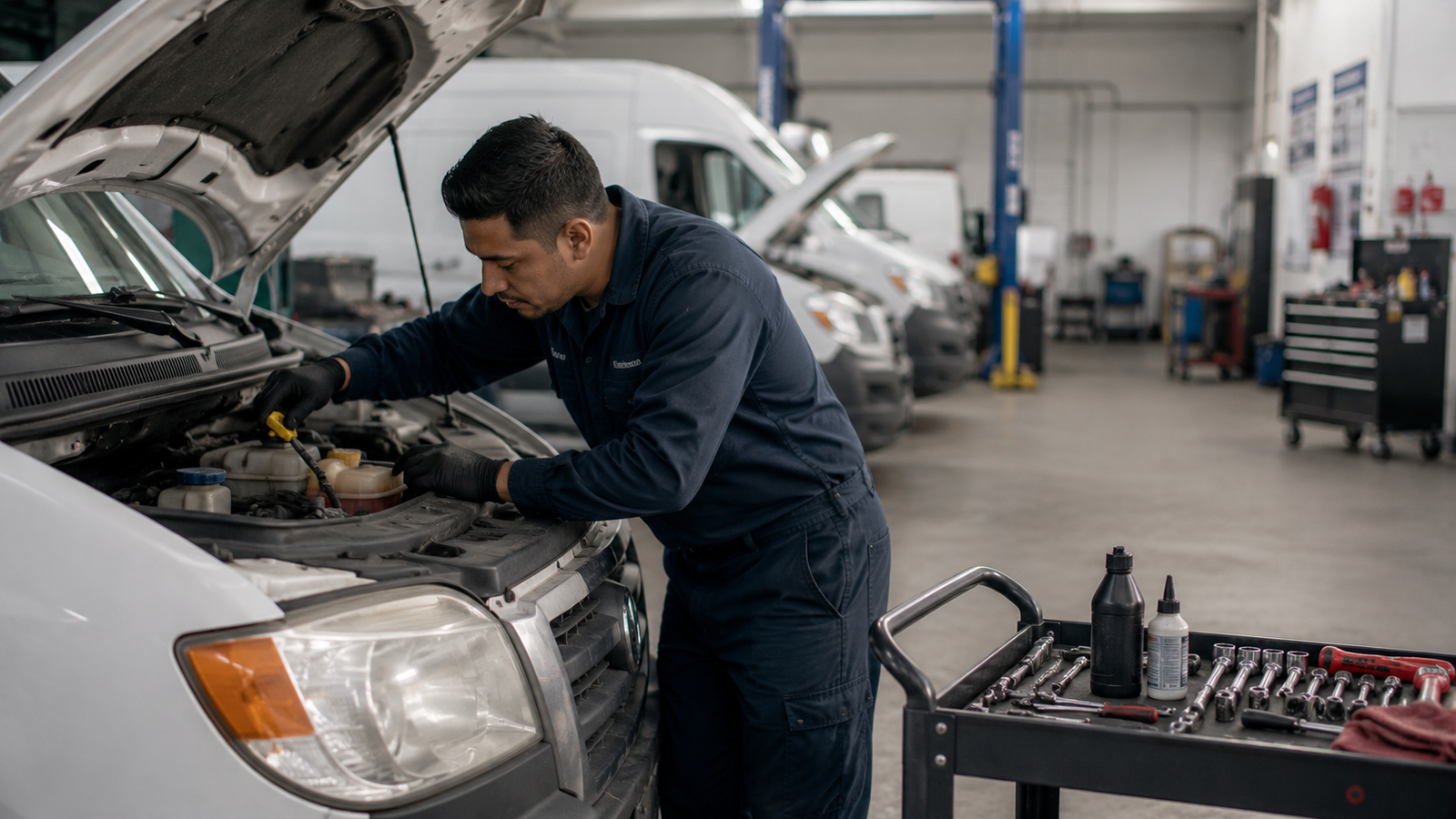
A van that needs a brake job in September is a van that misses routes in December if nobody schedules the service. Fleet maintenance is the most time-sensitive peak preparation task — not because it's the most important, but because the window to do it closes first. Service bays book out weeks in advance as peak approaches, and a breakdown on your busiest delivery day of the year costs far more in missed packages, overtime, and scorecard damage than the service appointment that would have prevented it.
The checks that determine whether a van is safe to operate at peak pressure — brakes, tires, steering. These can't wait.
The systems that affect reliability and driver experience during long peak days — engine, fluids, heating, cargo area.
The systems that keep drivers productive and connected during long peak days — navigation, connectivity, comfort.
Check off each completed item to see your fleet readiness score.
Schedule every van's service now — before bays book out. September appointments are available. November ones often aren't.
Brakes, tires, steering, battery — everything on the critical list done and signed off before the end of October.
Phone mounts, charging cables, route apps, cargo areas — every driver confirms their van is ready before volume climbs.
If the October and November work was done, peak week is just delivery. No emergency appointments. No missing vans.
The fleet maintenance window for peak is shorter than it looks. Service bays that have open slots in September are booked solid by mid-November — and a van that needs work but can't get a service appointment is a van that runs at risk through the busiest delivery period of the year. Book the appointments in September, complete the work in October, and peak week becomes a delivery operation rather than a maintenance crisis. The cost of the service is a fraction of the cost of a breakdown on the day you can least afford one.
Recalibrate Before the Volume Climbs
Routes set up for normal volume will break under peak volume — not dramatically, but consistently. Stop counts that were manageable at 110 become unmanageable at 140. Sequences that worked in September require rescues every afternoon in December. The time to find and fix these problems is before peak arrives, when there's room to adjust sequences, recalibrate stop counts, and test changes without the pressure of a full volume day behind it.
Any route that consistently finishes more than thirty minutes late in normal conditions will run ninety minutes late at peak volume. Trim the stop count now — before peak adds twenty percent on top of an already stressed route.
A sequence problem that causes two missed stops in normal conditions causes six at peak. The extra volume exposes every inefficiency in the sequence — tight turns, poor address ordering, backtracking. Fix the sequence before the volume makes it worse.
Peak is not the time for a new driver to learn a difficult route. Routes with complex sequences, heavy commercial stops, or high-rise buildings need your most experienced drivers during peak — not your newest ones still building confidence.
At peak volume, rescues are inevitable — the question is whether your schedule has room for them or whether every rescue cascades into a second and third problem. Build the rescue buffer before peak by keeping one driver on a lighter route who can absorb packages quickly if a nearby route needs help.
The route calibration window for peak closes when volume starts climbing — because once routes are running full peak loads, changing stop counts and sequences disrupts drivers who are already under maximum pressure. The recalibration work has to happen before that point, when there's still room to test changes, gather driver feedback, and make adjustments without adding stress to an already demanding operation. Routes that go into peak well-calibrated stay manageable. Routes that don't become the reason for daily rescues through the entire season.
Lock In the Protocol Before Peak Arrives
Peak season communication fails in a predictable way — not because the information is wrong, but because it arrives through the wrong channel, at the wrong time, in a format drivers can't act on while managing a route that's already running long. The communication habits that work on a normal day break under peak pressure unless they've been deliberately built and tested before the volume arrives. A driver who is confused about where to find updates at 2pm on the busiest delivery day of the year is a driver who makes decisions without information — and those decisions show up in the scorecard.
Peak is not the time to manage communication fragmentation. Pick the one channel every driver already uses and make it the only channel for all operational messages during peak — no texts to some drivers, no calls to others, no side group chats.
The stand-up format that works on a normal day needs a peak version — shorter, more specific, focused on the three things drivers actually need to know before a long peak day. What's the volume today, what's the weather, what's the rescue protocol if someone runs long.
A brief midday check-in — not a call, a single message to the group channel — gives drivers a moment to flag problems before they compound. "How's everyone tracking?" sent at noon on a peak day catches the routes running dangerously long before they need a rescue at 4pm.
Specific, actionable, tells drivers exactly what changed and what to do if it becomes a problem.
Vague, no numbers, no action required, no threshold for escalation. Drivers have no idea what "longer than usual" means or when to flag a problem.
Route-specific, has a clear safety action, gives drivers permission to stop if needed.
No specifics, no action, no route information. "Be careful" tells a driver nothing they can act on.
Names specific drivers, specific stops, specific location. One driver knows to ask, the other knows to confirm.
No names, no locations, no specific stops. Three drivers wonder if they should respond. Nobody moves for ten minutes.
Acknowledges the day, sets expectations for tomorrow, gives drivers a channel to raise issues before the next morning.
No acknowledgment of the day's effort, no information about tomorrow, no channel for issues. Drivers go home with unresolved questions.
Before the first peak day, every driver in the operation needs to know three things with complete clarity. Not assumed, not implied — stated explicitly in the last stand-up before volume climbs.
The channel name, confirmed out loud. "Everything comes through here — nothing through text, nothing through calls unless it's an emergency."
"If you're tracking more than 45 minutes over at noon, message me. Don't wait until you're two hours over — flag it at 45 minutes."
One backup number. One person. "If the app goes down or you can't reach me on the channel, call this number." Stated once, written somewhere visible.
| Situation | Do this | Not this |
|---|---|---|
| Volume update | Specific numbers — "8–12 extra stops today"Drivers can plan around a number. They can't plan around "a bit more." | "Volume is up — do your best"Vague — no action possible. |
| Weather warning | Route-specific — "Riverside section of routes 2, 5, 8"Tells the right drivers to slow down in the right places. | "Be careful out there"Heard and immediately forgotten. |
| Rescue trigger | Name the driver, name the stops, name the locationZero ambiguity — one driver moves, one driver confirms. | "Can anyone help route 6?"Three people wonder if they should respond. Nobody moves. |
| End of peak day | Acknowledge effort, set tomorrow's expectationDrivers go home knowing what tomorrow looks like. | "Thanks see you tomorrow"Unresolved questions go overnight. |
| Problem escalation | Set a threshold: "flag at 45 min over — not 90"Problems get flagged while there's still time to act. | "Let me know if there are issues"Drivers decide what counts as an issue — usually too late. |
The communication protocol for peak doesn't need to be complicated — it needs to be explicit. One channel, one threshold for escalation, one backup contact. Those three things stated clearly before peak starts are the difference between a driver who flags a problem at noon when there's still time to act and a driver who struggles through until 6pm and then sends a message nobody expected. Build the protocol before peak. Practice it once. Then trust it when the volume arrives.
The buffer that covers December gets built in September. Hiring in November is already too late for peak.
A breakdown on your busiest day costs more than the service that would have prevented it. Book September.
Routes set for normal volume break under peak. Fix stop counts and sequences before December, not during it.
One channel, one escalation threshold, one backup contact. All three stated explicitly before the first peak day.
Peak Season Doesn't Break Unprepared Operations — It Reveals Them
The DSP that sails through peak didn't get lucky — they made a decision in September that most operations don't make until November. They hired before it was urgent, serviced the fleet before the bays were booked, recalibrated the routes before the volume made changes impossible, and built the communication protocol before drivers were too tired and too busy to learn something new. None of it was complicated. All of it required starting earlier than felt necessary.
Peak season is a pressure test, not a surprise. The volume, the timeline, and the challenges are all predictable — which means the preparation is entirely possible. The operations that struggle through peak every year aren't struggling because peak is hard. They're struggling because the decisions that would have made it manageable got made too late, in too much of a rush, under pressure that didn't exist ninety days earlier.
How many drivers do you need to cover peak volume plus a two-driver buffer? That number is your hiring target. Post the job this week — not next month.
Call the service bay today. Book every van's October appointment before the slots fill. One phone call in September prevents a crisis in December.
Score each pillar — Staffing, Fleet, Routes, Communication — against the prep checklist. Any pillar with gaps gets a named owner and a deadline before November starts.
The operations that come out of peak in good shape — scorecard intact, drivers still engaged, no emergency repairs or last-minute scrambles — didn't get there by managing peak well. They got there by preparing for it early enough that peak never became an emergency. That preparation starts ninety days out, with four decisions that take less than a day to make and weeks to undo if they're skipped. Make them now, before the calendar makes them urgent.