Why Your Drivers Keep Missing the Message
How the right channel, timing, and tone prevent miscommunication from becoming a missed delivery — and keep your team connected all day long.
Fragmented channels mean missed messages. One committed channel fixes the problem entirely.
Missed changes, unread priority flags, and warnings sent too early to matter.
Drivers who can report back catch more problems early and feel like part of the operation.
Pick one and commit. Fragmented channels mean missed messages.
Send information when it's relevant, not all at once at 6 a.m.
Short, specific, actionable. Drivers in vans can't read paragraphs.
Give drivers a way to report back and actually respond when they do.
Mix recognition in. A channel only used for problems gets ignored.
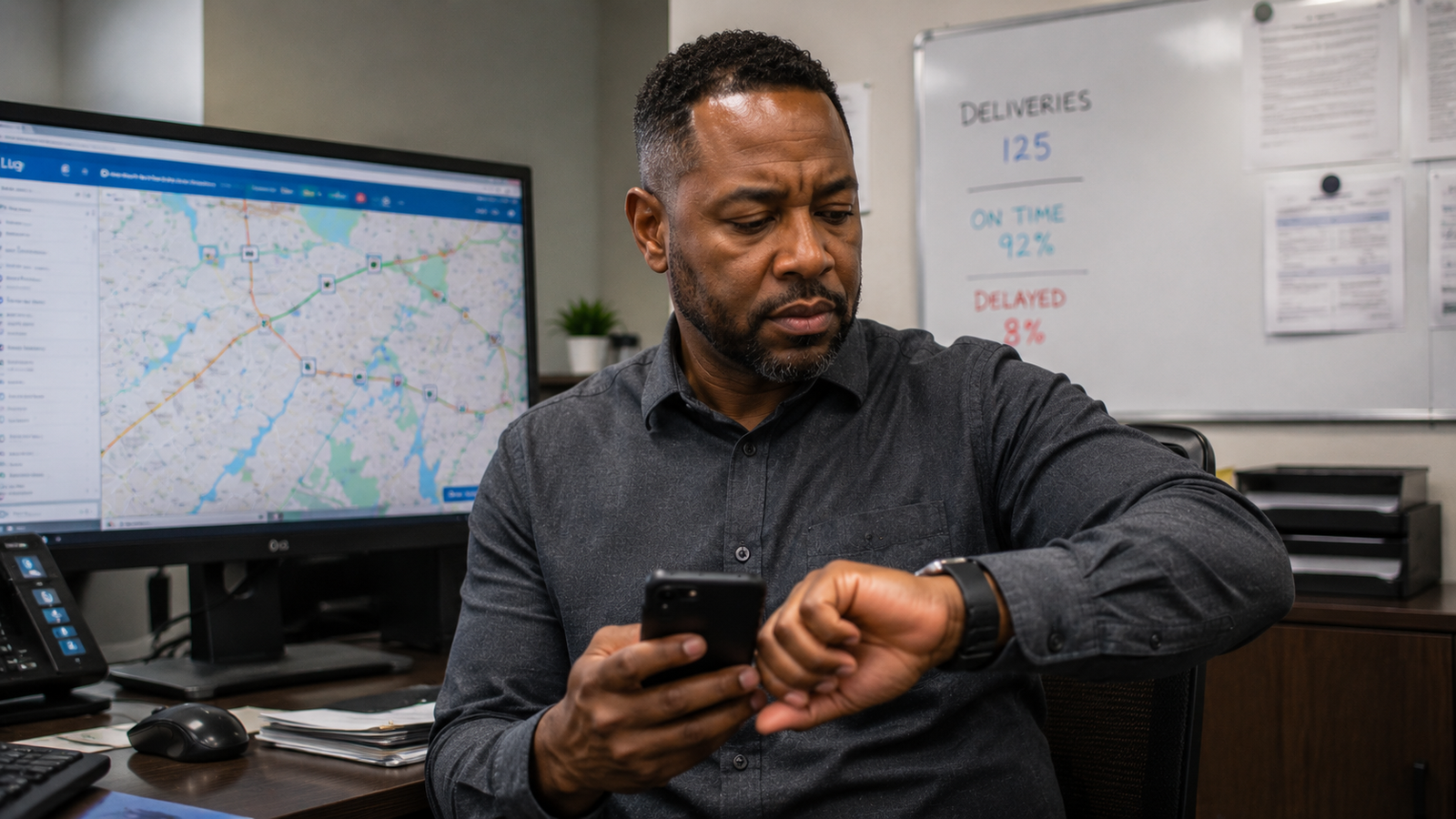
The route change went out at 6 a.m. in a group chat with forty other messages. By 9 a.m. the driver still hadn't seen it. By 11 a.m. the detour had added forty minutes and two packages were late. Nobody did anything wrong — the system just made it easy to miss.
In a delivery operation, communication breakdowns show up directly in your metrics. A driver who didn't get the message about a route change adds forty minutes to their day. A team that didn't hear about a priority delivery misses a window that a customer won't forgive twice. A manager who only communicates at the morning stand-up and end-of-shift leaves a twelve-hour gap where problems develop in silence. Communication isn't a soft skill in last-mile delivery — it's an operational system, and gaps in it cost real money.
The good news is that fixing it doesn't require new technology or a bigger team. It requires five habits, applied consistently, that make information reliable — the right message, reaching the right driver, at the right moment, in a way they can actually act on. Here's what those habits look like in practice.

Pick One Channel — Then Actually Commit to It
The most common communication problem in DSP operations isn't a tool problem — it's a fragmentation problem. When information travels through texts, calls, group chats, a separate app, and word-of-mouth all at once, the system breaks down not because anyone is careless but because the setup makes it structurally easy to miss something. A driver who checks three different places for messages will eventually check the wrong one first. The fix is brutally simple: pick one channel and make it the only channel for operational communication.
WhatsApp, iMessage, or a similar platform with a single group just for operational messages — no personal chat, no side conversations. Simple, familiar, and already on every driver's phone.
Best for most DSPsIf your dispatch platform has built-in messaging, using it keeps communication tied to the route data — drivers get messages in context, in the same app they're already using. Less switching, less friction.
Good if already using oneSome operations run entirely on calls — no texts, no apps. It works for urgent issues but creates no paper trail, can't reach multiple drivers at once, and puts the burden entirely on someone being available to answer.
Avoid as primary channelThe channel itself matters less than the commitment. A WhatsApp group that everyone checks reliably beats a purpose-built dispatch platform that half the team ignores. The test is simple: when you send a message, does it reach every driver who needs it, every time? If the answer is yes, you have the right channel. If the answer is "usually" or "it depends," the channel isn't the problem — the commitment is.
Once you've picked the channel, make the rule explicit: operational messages go here, only here, every time. Not "try to use this" — actually use it, every single time, without exception. The first few weeks of enforcing that discipline are the hardest. After that, it becomes the default and the fragmentation problem quietly disappears.
One channel doesn't mean one conversation. You can still call a driver directly for something urgent, still have a face-to-face in the depot. The rule is about where operational information lives — the record that every driver can check, the message that doesn't depend on anyone being in the right place at the right time. Make that single, make it consistent, and the first and most common communication failure in last-mile operations simply stops happening.
The Right Message at the Wrong Time Is Still a Missed Message
Most communication problems in DSP operations aren't about what gets said — they're about when. A route change sent at 6 a.m. for something that doesn't happen until 2 p.m. gets buried under everything that came after it. A weather warning that goes out an hour after drivers have already left the depot is more frustrating than helpful. The message was sent; the message was missed. And from the driver's perspective, those are the same thing.
This is the one moment drivers are actively looking for information — who drives what, which route, any overnight changes. Keep it to just that. Anything not relevant to the next sixty minutes will get missed in the pre-departure rush.
"Marcus — van 04, north route. James — van 07, south. Swap from yesterday."
Road closures, access code changes, customer notes, or anything that affects routes in progress. Drivers are between stops and actively checking messages. This is your highest-read window of the day — use it for anything time-sensitive.
"Oak St closed between 3rd and 5th — road works. Use Maple Ave. Affects north route stops 18 to 22."
Any priority deliveries that need to hit a window in the next two to three hours. Route progress check if anything looks like it might need a rescue. A quick recognition note for anyone running clean — it lands well at this point in the day.
"Reminder: stop 34 on south route has a 2 p.m. business delivery window. Don't leave it to the end."
Anything that needs logging from today, and any early information about tomorrow that drivers should know before they go home. Keep it short — drivers finishing a full day want to debrief and leave, not read a wall of text in the depot parking lot.
"Good work today everyone. Tomorrow: three new stops added to the west route. Details in the morning brief."
The habit to build is simple: before you send any message, ask one question — is this information relevant to what the driver is doing right now, or in the next two hours? If yes, send it. If not, hold it until it is. That single filter cuts the noise dramatically and makes the messages that do go out far more likely to actually land.
Well-timed communication also builds trust. A driver who consistently gets the right information at the right moment starts to rely on the channel — they check it because it's always useful, not because they're hoping something important isn't buried in there somewhere. That reliability is what turns a communication tool into a communication system.
Timing isn't just about the clock — it's about context. A message that arrives when a driver is loading the van, navigating traffic, or finishing their last ten stops is a message that competes with everything else happening at that moment. Send information when drivers have a moment to absorb it and act on it, and the same words will land completely differently than they would at 6 a.m. buried under twenty other notifications.
Right timing costs nothing. It just requires the discipline to hold a message for two hours instead of sending it the moment you think of it — and the awareness that when information arrives matters almost as much as what it says.
Drivers Can't Read Paragraphs Between Stops
A delivery driver's day is a constant sequence of micro-decisions made at speed — pulling up to an address, scanning a package, finding the right door, reading the delivery notes, moving on. In that environment, a message that requires two readings to understand is a message that gets misunderstood. Not because the driver isn't paying attention, but because the format is wrong for the context. Brief, specific, and actionable isn't just a style preference — it's a practical requirement for communication that actually works in a last-mile operation.
"Hey everyone just wanted to let you all know that there's some construction happening near the Oak Street area today so you might want to think about taking an alternate route if you're heading that way, maybe Maple Avenue could work as an alternative but use your judgment."
Vague, uncertain, and requires the driver to interpret what to actually do.
"Oak St closed — use Maple Ave. Affects stops 18–22 on north route."
Specific, clear, instantly actionable. Driver knows exactly what to do.
"Just a reminder to everyone that we've been seeing some issues with photo-on-delivery compliance recently and it's been affecting our scorecard so please make sure that you're taking photos for every single delivery especially at apartment complexes and businesses where it might not be obvious."
Long, vague, and contains no specific action. Driver files it under "noted" and moves on.
"Photo compliance dropped this week. Every delivery needs a photo — especially apartments and businesses. No exceptions."
Short, direct, specific. Driver knows exactly what changed and what to do about it.
"I just wanted to give everyone a heads up that stop 34 on the south route today has a specific delivery window and the customer has been in contact with us about it so it would be great if whoever is on that route could try to make sure they get there within the requested time frame if at all possible."
Uncertain and vague. "If at all possible" signals it's optional. Driver may deprioritize it.
"Stop 34, south route: priority window 2–3 p.m. Do not leave it to the end of the route."
Clear, firm, and specific. Driver knows exactly what the priority is and when.
If a message tries to cover three things at once, it covers none of them well. Send three short messages if you have three things to say. Each one lands cleanly; one long one gets skimmed and the third point gets missed.
Start with what the driver needs to do, not the context behind it. "Use Maple Ave — Oak St is closed" lands faster than "Oak St is closed so use Maple Ave." The action first, the reason second, always.
"Just wanted to let you know," "as a reminder," "if possible" — these phrases add length and reduce clarity. Every word in a driver message should be load-bearing. If it doesn't change what the driver does, cut it.
"You might want to think about" and "maybe consider" signal to the driver that this is optional. If it's important, say it directly. If it's genuinely optional, it probably doesn't need to be a message at all.
The test for every message is simple: could a driver read this, understand it, and know what to do in under ten seconds? If not, it needs to be shorter. That bar feels harsh until you picture the context — a driver standing at a door with a package under their arm and a phone in one hand. That's who you're writing for. Write accordingly.
Brevity also builds credibility. A manager who consistently sends short, useful, specific messages trains their team to read every message they send — because it's always worth reading. A manager who sends long, vague, everything-covered messages trains their team to skim — and eventually to stop reading at all. The reputation of the channel is built one message at a time.
Being brief doesn't mean being cold. A message can be short and still be warm — "Good work today, Marcus" is six words and does more than a paragraph of general praise. Brevity is about respecting the driver's context, not stripping the humanity from the communication. Short, specific, and human is the standard. Anything longer than that needs a very good reason.
Communication That Only Goes One Way Isn't a System — It's a Broadcast
Most DSP communication flows in one direction: manager to driver. Updates, instructions, reminders — all outbound. Drivers receive, drivers acknowledge, drivers move on. What that model misses is the most valuable intelligence in the operation: what drivers are actually seeing on the ground. A closed road that isn't on any map. A building access code that changed. A customer who moved their packages to a different entrance. That information exists — it's just sitting in the cab of a van, going nowhere, because the system wasn't built to receive it.
Building a two-way communication habit doesn't require a new platform or a formal feedback system. It requires two things: giving drivers a clear, easy way to report back, and actually responding when they do. The second part is the one most operations get wrong. A driver who sends a message and gets no response will send one or two more before quietly stopping. The channel becomes read-only again — not by policy, but by neglect.
What drivers report back isn't noise — it's signal. A driver who flags a consistently difficult access point is giving you information that prevents the same problem for every driver who follows. A driver who reports a customer complaint early gives you a chance to respond before it escalates. A driver who notes that a route is consistently running thirty minutes over is telling you the stop count needs looking at. Every one of those messages is worth more than the thirty seconds it takes to respond.
The cultural shift matters as much as the mechanics. When drivers see that their messages get read and acted on, they start treating communication as a tool — something that improves their day, not just a channel they're obligated to check. That shift in relationship is what makes the whole communication system work better in both directions.
Drivers spot closures, changed access codes, and blocked entrances that dispatch can't see from the depot. A two-way channel captures that in real time.
A complaint or compliment that a driver hears on the doorstep should reach the manager the same day — not a week later when the customer emails.
A driver who flags that they're running behind at 1 p.m. gives dispatch time to act. One who stays silent until 5 p.m. has already made the problem unsolvable.
A warning light, a strange noise, a door that doesn't close cleanly — reported early, these are maintenance items. Reported after a breakdown, they're emergencies.
Road closed, customer issue, route running long — something dispatch doesn't know yet.
Short, specific, in the designated channel. One message, one point.
Acknowledges it, acts on it, or logs it. Response doesn't need to be long — just visible.
Because they know it gets read. The habit compounds — more signal, better operation.
Operations with active two-way channels catch route issues, customer problems, and vehicle faults significantly earlier.
Drivers who feel heard are more engaged, report problems earlier, and stay longer than those who feel like a one-way receiver.
Issues flagged early are almost always cheaper and faster to solve than the same issues discovered at end-of-shift or via a customer complaint.
The simplest way to build the two-way habit is to respond to every driver message for two weeks straight — even with just "got it" or "on it." That consistency signals to the team that the channel is live in both directions, and within a few weeks the reporting behavior starts to shift. Drivers who rarely sent anything unprompted will start flagging things proactively, because they've learned it's worth doing.
Two-way communication also changes the manager's relationship to the operation. Instead of relying entirely on end-of-day reports and telematics data, you get a running picture of what's actually happening on the ground in real time. That picture is more accurate, more current, and more actionable than anything you can reconstruct after the fact — and it comes at no cost beyond the habit of responding.
The test is simple: when was the last time a driver sent you an unsolicited message about something they spotted on the road? If the answer is rarely or never, the communication is one-directional — and you're missing the most valuable input in your operation. Open the channel, respond consistently, and the intelligence starts flowing. Most managers are surprised by how much their drivers already know that nobody ever thought to ask them.
A Channel Only Used for Problems Eventually Gets Ignored
Tone is the habit most managers don't think about until it's too late. A communication channel that only ever delivers instructions, corrections, and problem notifications trains drivers to associate it with bad news — and eventually, with something to be avoided. They still check it because they have to, but the engagement is grudging rather than genuine. The fix isn't complicated: mix recognition into the same channel, in the same flow, as a normal part of how the operation communicates. Not as a separate program. Not once a week. As a habit, woven into the daily communication rhythm.
Every message is operational — route changes, corrections, reminders, and warnings. Accurate and efficient, but it signals to drivers that the channel is purely transactional. They check it for information, not because they feel connected to it.
Most messages are operational, but recognition is woven in naturally — a quick acknowledgment after a clean day, a specific call-out for a driver who handled something well. The channel carries the whole relationship, not just the logistics.
Heavy on praise, light on useful information. "Great job team!" every morning loses meaning quickly and starts to feel performative. Drivers tune out generic positivity the same way they tune out generic criticism — it has no specific weight.
Specific driver, specific route, specific reason. Lands completely differently than "good job everyone."
Names the behavior you want more of. Other drivers notice what gets acknowledged.
Collective recognition that builds team identity rather than just individual praise.
Milestone recognition that signals to new drivers that safe, consistent work gets noticed from the start.
Route changes, priorities, weather, vehicle info — the essential daily content that keeps routes running.
One driver, one specific thing, once a day minimum. Named, genuine, and tied to a real behavior.
A metric that improved, a trend to watch, or a pattern worth naming — framed as information, not criticism.
The ratio matters. A channel that's 90% operational and 10% recognition feels balanced — the recognition lands because it's genuine and specific, not because it's constant. A channel that's 50% praise feels performative. Aim for one recognition moment per day, mixed naturally into the flow of operational messages, and the tone takes care of itself.
Tone also shapes how drivers interpret the operational messages. In a channel where recognition is normal, a correction lands differently — it feels like useful information rather than an attack. In a channel where everything is negative, even a neutral message gets read with suspicion. The tone you build over weeks is the context every individual message gets read against.
Getting the tone right doesn't require a communications strategy or a culture initiative. It requires one habit: before you send the last operational message of the day, ask whether there's one driver who did something worth naming today. Usually there is. Thirty seconds to name it, in the same channel, in the same flow — and over time the character of the communication changes in a way that shows up in engagement, retention, and the willingness of your team to keep that channel open and active.
That's what all five habits add up to. One channel, right timing, brief and specific, two-way, and the right tone — not a communication overhaul, just five consistent decisions that make information reliable and the relationship between manager and driver something worth maintaining on both ends.
Pick one. Commit to it. No exceptions.
Send it when it's relevant, not when it's convenient.
Short, specific, actionable. Nothing more.
Open the channel. Respond when drivers use it.
Mix recognition in. Don't just broadcast problems.
Most DSPs communicate reactively — when something goes wrong, when a change needs announcing, when a driver makes a mistake. The operations that run cleanly do the opposite: they build a system that makes information reliable, consistent, and two-directional, every day, regardless of whether anything has gone wrong. The five habits in this article aren't complicated. They just require the discipline to apply them consistently — and once you do, the results show up quietly in fewer missed deliveries, better-informed drivers, and a team that actually feels connected to the operation they're running.
Pick one channel. Send the next operational message there only. Tell your team that's where everything lives from now on.
Even "got it" is enough. Two weeks of consistent response changes how drivers use the channel.
Specific, genuine, thirty seconds. Do it for a week and watch how the tone of the whole channel shifts.
None of this requires a budget, a new app, or a team meeting about communication. It requires three decisions — one channel, one response habit, one recognition moment per day — repeated consistently until they become the default. The gap between a DSP where drivers feel informed and connected and one where they feel out of the loop is almost always found in those three things. Close the gap and everything else in the operation gets a little easier.